 Buyer's guide
9 min read
The best knowledge base software for agencies, judged at the fifteenth client
September 15, 2026
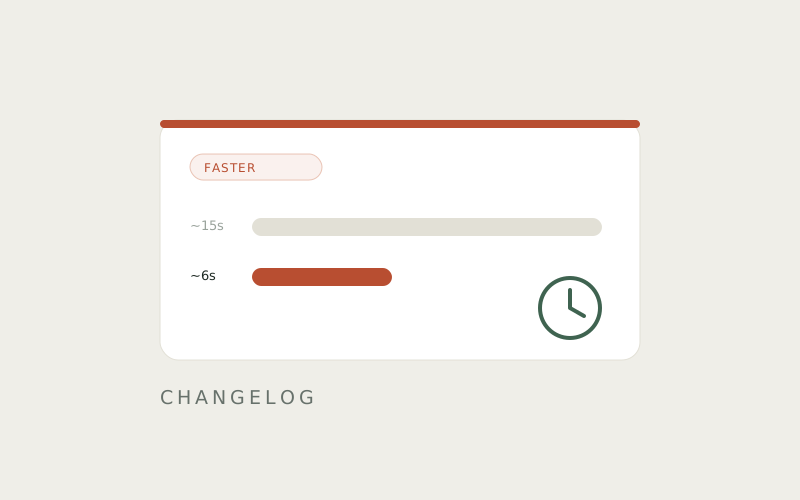
Fifteen seconds is a long time to watch a cursor blink. It is long enough to open another tab, long enough to decide the chat is broken, and long enough that a fair number of readers give up and email the person who built the help center instead — which is the one outcome the chat exists to prevent.
Doc AI now answers in about six seconds.
Two things, and neither of them was the model writing the answer.
The first was the search that runs before it. Every question begins with a search across that hub's published docs, because Doc AI is not permitted to answer from anything else. That search was doing more work than the question needed: casting wider than it had to, ranking candidates that would never be read, and continuing well past the point where it had already found the right guide.
The second was what the search handed over. It was passing the model a larger share of the hub than the model could use. More text going in means more time spent reading it, and beyond a certain volume the extra text stops improving the answer — it sits in the middle of the request adding seconds and nothing else.
The search now stops once it has what it needs, and passes forward a tighter set of docs. Same index, same ranking signals, fewer wasted passes. The model receives less and returns the same answer sooner.
The scope. Doc answers only from that hub's published docs, cites the guide and step behind every answer, and opens a ticket instead of guessing when the docs genuinely do not cover the question.
That distinction matters more than the clock does. An assistant that got faster by widening what it was allowed to read would be a worse assistant no matter what the timer said, because the thing being sold here is not speed — it is that an answer on a client's help center came from that client's documentation and can be checked against it. Nothing about what Doc is permitted to read has moved. It is the same scope, reached faster.
Answers arrive whole rather than typing out a word at a time. That is a deliberate trade and it is worth naming, because it changes how six seconds feels.
A chat that streams its answer looks busy from the first half-second. A chat that returns the finished answer looks idle until it does not. The finished answer is the honest one: Doc is checking what it found against what it is allowed to say, and assembling the citations, before any of it reaches the reader. Showing a sentence that a later check might retract would make the wait feel shorter and the answer less trustworthy.
So the six seconds is six seconds of nothing visible, then the whole answer with its sources underneath it.
Open your hub and ask it something you know is documented. The answer comes back in roughly the time it takes to read your own question again, with the guide it came from named below it.
Then ask it something you know is not covered, and watch it decline and open a ticket. That one is slower to arrive at, and it should be.
Readers who were always going to wait were already waiting. The ones worth caring about are the others — the person with the tab half closed, deciding whether this is worth the trouble. Six seconds sits inside the window where they stay.
Capture a process, publish it as a help center under your own name or a client's, and answer the repeat questions from what you published.