 Buyer's guide
9 min read
The best knowledge base software for agencies, judged at the fifteenth client
September 15, 2026
The failure mode nobody warns you about with a support chat is not that it says "I don't know." It is that it does not.
A reader asks something the documentation never covered. The chat has read a great deal of adjacent material, and adjacent material is enough to assemble a paragraph that sounds correct. The reader follows it. The step does not exist. Then they email you, and now you are answering the original question and undoing an invented one — on a help center with your client's name at the top of it.
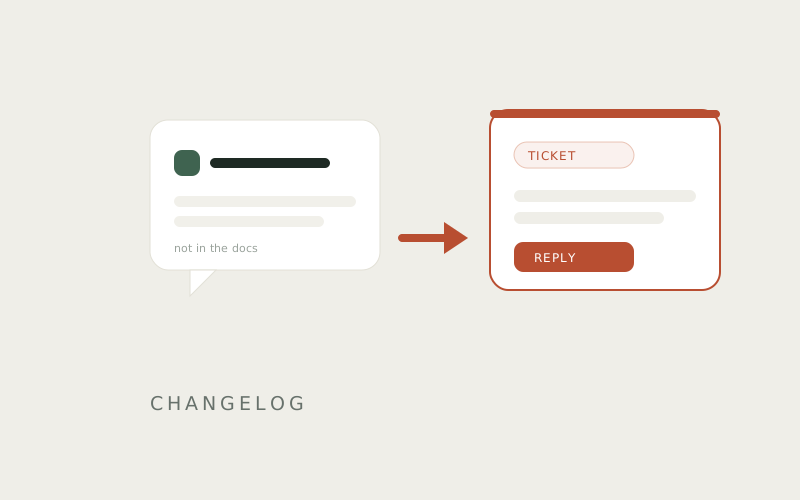
Doc AI now opens a ticket at that moment instead.
This is the part that determines whether any of it holds up, so it is worth being specific about.
Whether Doc answered is a field Doc returns, alongside the answer itself. It is not inferred afterward by looking for apologetic phrasing in the text. Nothing scans the reply for "I'm not sure" or "unfortunately," because a model that has decided to be helpful will write a confident paragraph with no such phrase in it, and phrase-matching would pass that straight through to the reader.
So the question Docssier asks is not "does this answer sound uncertain." It is "did Doc report that the docs covered this." When the answer is no, the reply the reader gets is the honest one and a ticket is created in the same moment.
Confirmed end to end on 26 August.
A plain sentence saying the documentation does not cover it yet, and that someone will reply. No apology theater, no cheerful redirect, no suggestion that they try rephrasing it — rephrasing does not add a guide that was never written.
The reader's question stays in their thread. Your reply, when you write it, appears in that same thread where they left it.
The ticket lands in your Inbox with the question as the reader typed it.
That last detail does more work than it looks like it does. The question in your Inbox is not a category, a tag, or a summary of a category. It is the sentence a real person typed while stuck on something, in their own words, which is usually not the words your documentation uses. Guides get written from the inside, by the person who already knows how the thing works. The Inbox is the outside view, arriving unprompted.
Read a month of it and you have a writing queue in priority order, ranked by how often people needed something that was not there.
Docssier can draft a reply for you, and every draft carries a flag showing whether it was grounded in your docs.
When the answer is in the documentation somewhere, the draft says so and points at it. When it is not, the draft is an honest holding reply rather than an invented set of steps — because the whole point of the ticket was that the documentation did not cover this, and a drafting tool that quietly filled the gap would put the problem back exactly where it started.
Nothing sends on its own. AI-drafted text stays marked as AI-written until you have read it and sent it.
Support assistants are usually sold on deflection rate: the share of questions that never reach a person. It is a straightforward number to improve, and the fastest way to improve it is to answer everything.
A question that reaches you is not a failure of the chat. It is the chat doing the one thing that keeps the other answers worth trusting.
Capture a process, publish it as a help center under your own name or a client's, and answer the repeat questions from what you published.